Latest posts


Jul 28
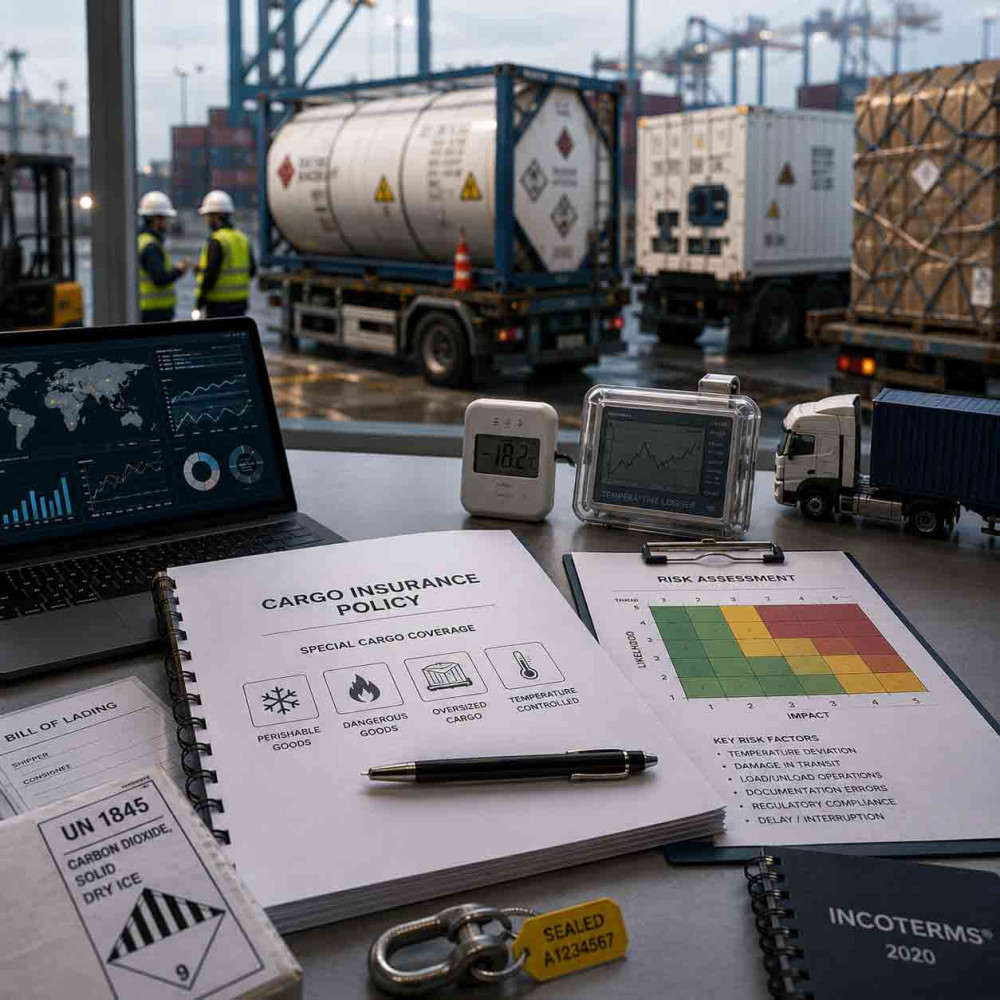
Specialized Cargo and Insurance: Who Really Bears the Risks?
Introduction
Why does insurance in specialized cargo logistics create a sense of security without eliminating actual risks? Why do companies continue to face financial losses, disputes, and unpredictable consequences despite having insurance policies? In 2026, insurance is no longer viewed as a universal protection mechanism but rather as part of a complex risk allocation system in which actual liability often differs from formal responsibility.
The core issue is that insurance is commonly perceived as a compensation mechanism, while in reality it merely defines the conditions under which compensation may be granted. Any deviation from those conditions—including documentation errors, process non-compliance, or cargo-specific characteristics—may result in a denied claim. As a consequence, risks do not disappear; they are simply redistributed, and not always in the business's favor.
This is particularly evident in the transportation of specialized cargo, including perishable, hazardous, and oversized shipments, where the number of variables is significantly higher and the likelihood of deviations increases. Under these conditions, insurance becomes not a form of protection but a component of the overall business economics that requires dedicated management and continuous analysis.
Why Insurance Does Not Equal Protection
The traditional perception of insurance is based on the idea of transferring risk. A company pays an insurance premium and expects financial losses to be compensated if a problem occurs. However, in specialized cargo logistics, this model functions differently because insurance policies define only a limited set of circumstances under which compensation is available.
The key challenge lies in the gap between actual business risks and insured events. Many losses experienced by companies fall outside insurance coverage because they result not from obvious incidents but from gradual deviations. For example, deterioration in product quality, temperature excursions, or delivery delays may not qualify as insured events despite causing significant financial losses.
Insurance also requires strict compliance with policy conditions. Any deviation—from improper packaging to documentation errors—may become grounds for rejecting a claim. This means that even with insurance coverage in place, companies remain exposed to substantial risks unless their operational processes are executed flawlessly.
As a result, insurance serves less as a protection mechanism and more as a risk-filtering tool, compensating only those incidents that meet predefined contractual conditions.
Specialized Cargo: Increasing Risks and Limitations
Handling specialized cargo amplifies every aspect of risk management and insurance. These cargo categories involve a greater number of variables that can influence operational outcomes, making risk management significantly more complex.
Perishable cargo is vulnerable to gradual quality deterioration that is often difficult to classify as an insured event. Hazardous cargo requires strict compliance with regulatory requirements, where any violation may result not only in financial losses but also in legal consequences. Oversized cargo transportation involves a high degree of uncertainty, where even minor deviations can generate substantial additional costs.
At the same time, the importance of the human factor increases. Errors in preparation, coordination, or documentation become more likely, while their consequences become more severe. This significantly raises the probability of situations that fall outside insurance coverage.
As a result, specialized cargo creates an operating environment in which risks become multi-layered, while insurance represents only one element within a broader risk management strategy.
Where Losses Actually Occur
The largest financial losses in specialized cargo logistics are rarely caused by catastrophic events. More often, they arise from a sequence of relatively small deviations that accumulate over time and gradually reduce operational efficiency and profitability.
The primary sources of losses include:
- deterioration in product quality and market value;
- longer transit times and higher transportation costs;
- documentation errors;
- non-compliance with transportation requirements.
These losses are not always recognized as insured events, yet they have a direct impact on business profitability.
It is also important to recognize that even when an insured event occurs, compensation rarely covers the full extent of financial losses. Lost time, reputational damage, and operational disruptions remain the responsibility of the business, significantly increasing the overall economic impact.
The Illusion of Coverage: Where Insurance Falls Short
One of the most significant challenges is the illusion of comprehensive coverage. Simply having an insurance policy creates a sense of security, which can reduce attention to risk management. In reality, however, insurance covers only a limited range of events.
The most critical limitations include:
- exclusions from insurance coverage;
- transportation and handling requirements;
- the need to prove the cause of the loss;
- limits on compensation payments.
These factors make insurance a tool with inherently limited effectiveness.
Another important issue is the interpretation of policy terms. In disputed cases, compensation decisions often depend on how contractual conditions are interpreted, which can result in claim denials. Consequently, outcomes become less predictable.
Allocation of Responsibility: Who Ultimately Pays?
Formally, liability is distributed among all participants in the logistics chain, including carriers, freight forwarders, and insurers. In practice, however, this allocation rarely reflects reality.
The core problem is that responsibility is fragmented. Each participant is accountable only for their specific stage of the transportation process, while financial losses occur across the supply chain as a whole. As a result, situations frequently arise in which it is impossible to identify a single responsible party.
Conflicts further complicate the process. Participants may attempt to shift responsibility onto one another, delaying compensation and increasing both the time and resources required to resolve disputes.
As a consequence, a substantial share of the actual risks ultimately remains with the business itself, forcing companies to absorb losses despite having insurance coverage.
Business Mistakes: Where Money Is Lost
One of the most common mistakes is treating insurance as a substitute for risk management. Companies may pay less attention to operational processes because they rely on their insurance policy, thereby increasing the likelihood of costly deviations.
Businesses also frequently underestimate the importance of understanding insurance terms and conditions. Without a thorough understanding of policy provisions, companies often expect compensation that they ultimately fail to receive.
Another widespread mistake is selecting insurance based primarily on price rather than on the scope and quality of coverage. This reduces the level of protection while significantly increasing business exposure to risk.
How the Approach to Insurance Is Changing
In 2026, companies are increasingly viewing insurance as one component of an integrated risk management system rather than as a standalone solution. This means embedding insurance considerations directly into logistics and operational processes.
Comprehensive analysis becomes the key priority. Companies evaluate not only the cost of an insurance policy but also how effectively it addresses their actual business risks. This enables a far more precise and efficient approach to risk protection.
Transparency is also becoming increasingly important. Businesses must clearly understand which risks are covered and which remain their own responsibility.
Where the Boundary of Effectiveness Lies
The effectiveness of insurance is determined by the balance between its cost and the level of protection it actually provides. Companies must consider not only the price of an insurance policy but also its practical ability to mitigate real business risks.
This requires a systematic approach that evaluates the entire logistics chain rather than individual stages. Such an approach helps identify coverage gaps, improve operational processes, and optimize overall risk management.
Emerging Trend: Risk Management Instead of Insurance
A key trend in 2026 is the shift from relying primarily on insurance to focusing on comprehensive risk management. Companies are increasingly investing in processes and technologies designed to reduce the likelihood of operational deviations before losses occur.
This includes enhanced control, continuous monitoring, and data-driven analysis, enabling businesses to reduce their dependence on insurance as the primary protection mechanism.
At the same time, data is becoming a strategic asset. High-quality operational data provides the foundation for more effective risk management, better decision-making, and improved resilience throughout the supply chain.
Conclusion: Insurance as Part of the System, Not the Solution
The key conclusion is that, in 2026, insurance is no longer a universal solution and does not eliminate risks—it merely redistributes them within the framework of predefined contractual conditions. Insurance is effective only when risks are clearly defined, formally documented, and meet the policy's coverage criteria. In all other situations, the business ultimately remains responsible for the consequences.
The fundamental shift is that companies are beginning to view insurance not as protection itself, but as one component of a comprehensive risk management system. This requires a thorough understanding of policy limitations, the integration of insurance into operational processes, and continuous risk assessment. Without this approach, insurance becomes little more than a formality that fails to provide meaningful protection.
Companies that establish a systematic approach gain the ability to reduce losses and strengthen operational resilience. They manage risks at the process level while using insurance as an additional layer of protection rather than the primary safeguard. By contrast, businesses that rely solely on insurance policies often discover, at the most critical moment, that coverage is limited and that the most significant financial losses remain their own responsibility.
In 2026, the most important question is no longer whether the cargo is insured, but who actually bears the risk. In most cases, the answer remains the same—the business itself.
Your experience matters! Take a short survey and see how others answered. Take part