Latest posts


Jun 18
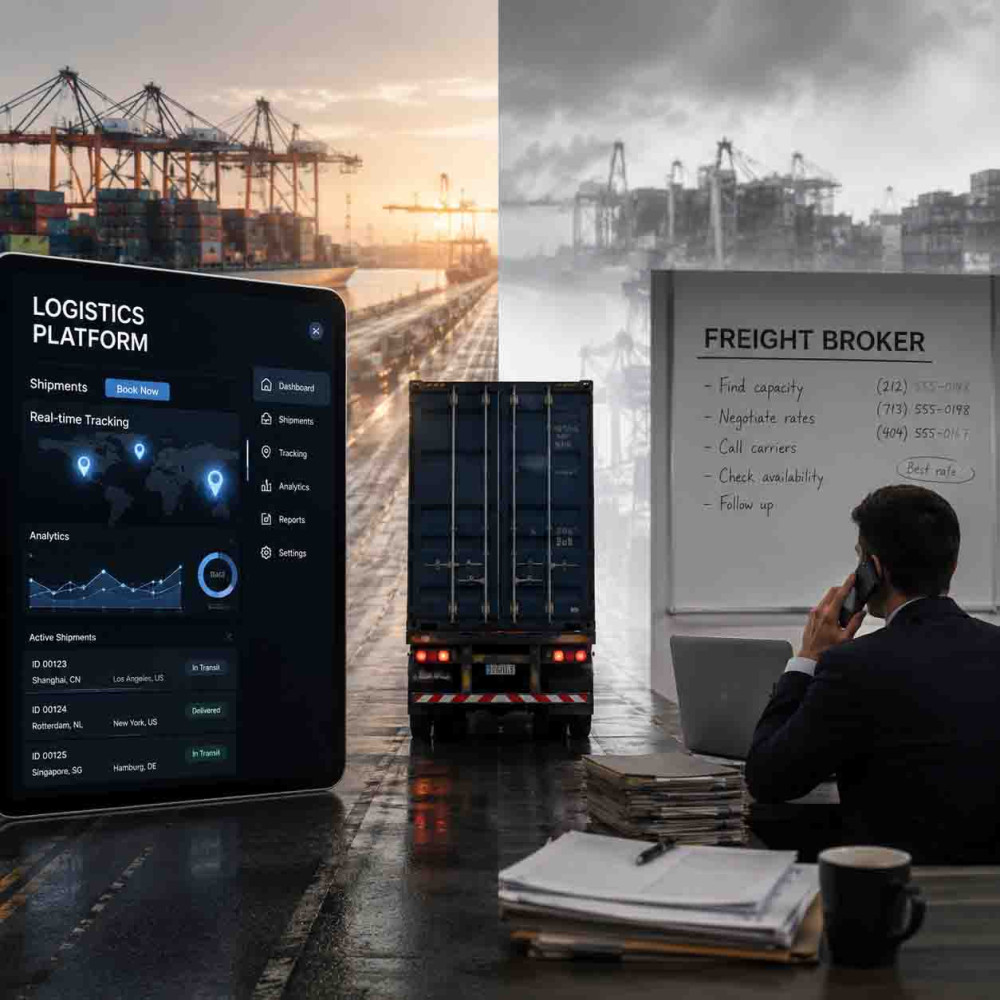
Platforms vs. Brokers: How the Logistics Services Market Is Changing
Introduction
Why are digital platforms, which promise transparency and efficiency, not replacing brokers despite their technological advantages? Why is the logistics services market in 2026 not shifting entirely to digital models but instead continuing to combine different formats? The main reason is that platforms and brokers solve different problems, and their competition is not direct.
Logistics remains a complex system with a high degree of variability, where not all processes can be standardized. Platforms offer scalability and speed but are limited when dealing with non-standard situations. Brokers, on the other hand, provide flexibility but are often associated with lower transparency.
As a result, the market is not replacing one model with another; instead, it is redistributing roles. This creates a new economic reality in which choosing between a platform and a broker becomes a strategic decision.
Why Platforms Do Not Replace Brokers
The main advantage of platforms lies in standardization. They make it possible to quickly find solutions, compare offers, and manage processes.
However, the key limitation is the inability to account for every possible scenario. Logistics often requires non-standard solutions that are difficult to automate.
In this context, brokers serve as an adaptive element. They can take context into account, adjust conditions, and find solutions that are not built into the system.
As a result, platforms and brokers perform different functions.
Where Platforms Deliver Value
Platforms are highly effective in segments characterized by a high level of standardization. Where processes are repetitive, they help reduce costs and improve transparency.
Key areas include:
• standard transportation services
• stable routes
• predictable operating conditions
In these cases, platforms provide speed and efficiency.
Where Brokers Remain Irreplaceable
In complex situations, brokers maintain a significant advantage. They can adapt and manage non-standard challenges.
Key areas include:
• unstable operating conditions
• complex cargo shipments
• urgent decision-making requirements
In these situations, the human factor becomes critical.
The Economics of Choice: Where Businesses Lose Money
The most common mistake is choosing the wrong model. Using a platform where flexibility is required can lead to disruptions. Using a broker for highly standardized processes can increase costs.
This creates a situation in which businesses lose money not because of the tool itself, but because of its inappropriate application.
Hidden Costs: When Platforms and Brokers Become Sources of Losses
Hidden costs associated with choosing between a platform and a broker are not created at the tariff level but at the level of decision consequences. In both cases, businesses face expenses that are not included in the initial calculation yet systematically affect overall economics.
In the case of platforms, the primary risk lies in limited scenarios. A platform performs efficiently within predefined logic, but when deviations occur—such as changing conditions, non-standard requirements, or operational disruptions—it loses flexibility. This leads to the need for manual intervention, recalculations, route changes, and sometimes even a complete restructuring of the operation. Such situations generate additional costs that are not reflected in the base price but account for a substantial share of total losses.
Another challenge is dependence on data quality. Platforms make decisions based on the information provided, and any inaccuracies can lead to errors that scale across the system. Unlike a broker, who can interpret a situation and make adjustments, a platform operates strictly according to predefined parameters, increasing the risk of incorrect decisions.
For brokers, hidden costs have a different nature. They are associated with opacity and variability. Service pricing may include not only operational expenses but also margins that are not always visible to the client. At the same time, service quality and execution standards may vary significantly depending on the individual broker.
Dependency becomes especially critical. Relationships with brokers are often built on personal connections and experience, making the system less scalable. As shipment volumes increase or conditions change, businesses may encounter limitations that are difficult to overcome without incurring losses.
Therefore, hidden costs are not generated by platforms or brokers themselves but by a mismatch between the chosen tool and the task. In both cases, the key factor is a company’s ability to understand the limitations of the model and incorporate them into its economic calculations.
How the Market Is Changing: From Choosing a Model to Managing a Combination
In 2026, the logistics services market is no longer a battleground between platforms and brokers. Instead, it is evolving into a hybrid system. Companies are moving away from binary choices and toward managing a combination of tools, adapting them to different types of tasks.
The key change is segmentation. Businesses are beginning to classify logistics operations according to their degree of standardization, risk level, and required flexibility. Standard and repetitive processes are transferred to platform-based solutions, where speed, transparency, and control are critical. At the same time, complex, unstable, or mission-critical operations remain within the broker domain, where adaptation and a personalized approach are required.
This approach makes it possible to redistribute workloads and reduce risks. Platforms handle volume by delivering efficiency, while brokers handle complexity by providing flexibility. As a result, the overall system becomes more resilient because each tool is used within its area of maximum effectiveness.
However, transitioning to a hybrid model requires a higher level of management. Companies must not only choose a tool but also understand when and how to use it. This includes developing decision-making criteria and integrating processes to avoid gaps between different operating models.
In addition, the importance of data continues to grow. The ability to compare results, analyze performance, and identify patterns becomes a critical success factor. Without this capability, a hybrid model can turn into a chaotic mix of tools that fails to deliver the expected benefits.
As a result, the market is moving not toward the dominance of a single model but toward greater management complexity. The winners are not those who choose a platform or a broker, but those who can effectively manage the combination of both.
Conclusion: Efficiency Is Determined by Management, Not by the Tool
The key conclusion is that in 2026, the question of choosing between a platform and a broker is no longer a strategic issue by itself. Neither model is universal, and effectiveness is determined not by the tool but by how it is integrated into the logistics management system.
The fundamental change is that logistics is no longer viewed as a collection of operations but as a managed system in which every element fulfills a specific function. A platform provides standardization and scalability, while a broker delivers flexibility and adaptation. However, neither element can operate effectively outside the context of an overall management model.
Companies that continue searching for a universal solution eventually discover that every tool reaches its limits. Platforms are constrained by algorithms, while brokers are constrained by human factors. In both cases, the absence of systematic management leads to rising costs and declining efficiency.
In contrast, businesses that build logistics architecture as an integrated system gain the ability to manage complexity. They do not simply choose a tool; they define its role, its boundaries of application, and its relationship with other elements. This makes it possible to minimize hidden costs, improve resilience, and adapt to changing conditions.
Within this framework, the main question is no longer “platform or broker.” Instead, it becomes: how effectively is logistics managed as a system, and how accurately does the company understand where the effectiveness of one tool ends and the need for another begins? This level of understanding ultimately becomes a key factor in competitiveness.
Your experience matters! Take a short survey and see how others answered. Take part