Latest posts


May 25
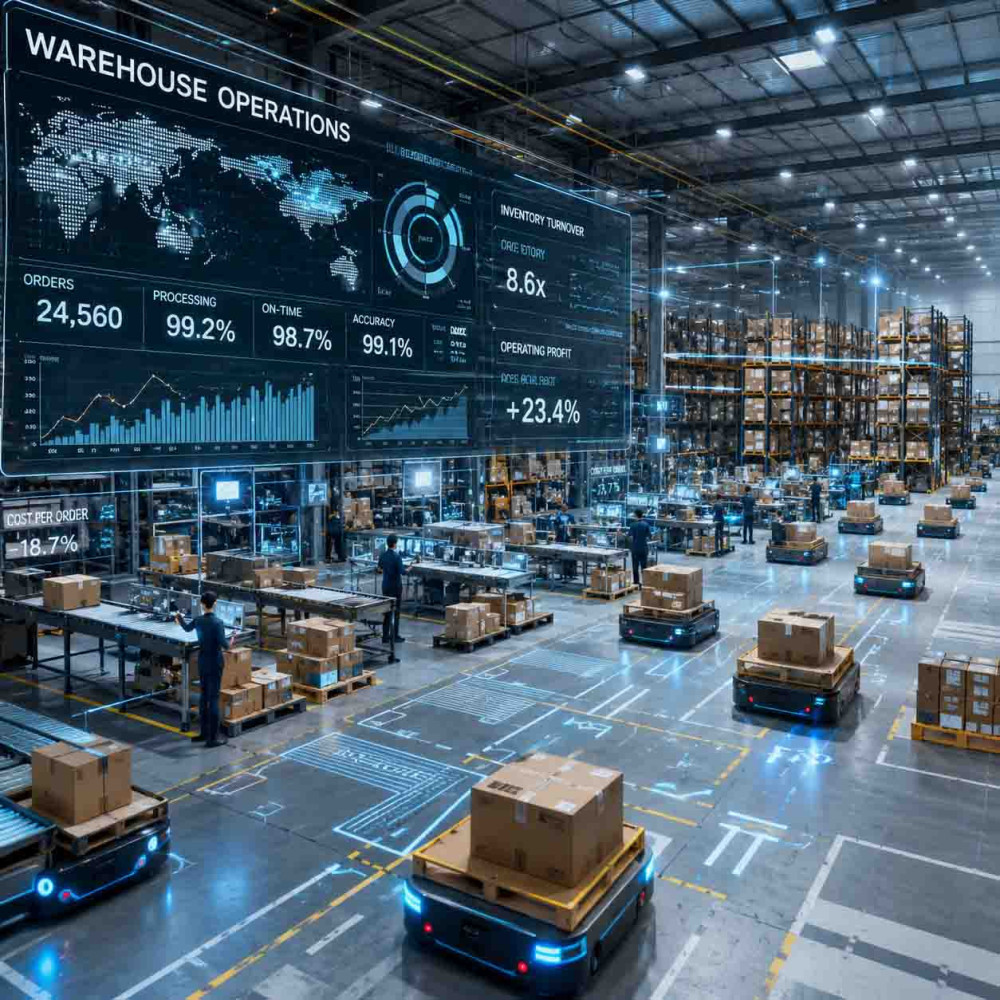
Warehouse as a Profit Center: Why Operations Matter More Than Transportation
Introduction
Why does logistics still focus most of its attention and budgets on transportation, while the real losses and profit opportunities are formed inside the warehouse? Why do companies optimize routes, tariffs, and transportation types, yet continue losing money within their own operations? In 2026, the warehouse is no longer auxiliary infrastructure and is becoming a key element of supply chain economics.
The main problem is that the warehouse is perceived as a storage point rather than an active operational system. As a result, management focuses on reducing space and costs instead of improving process efficiency. At the same time, it is inside the warehouse that goods are processed, distributed, assembled, and prepared for sale — meaning their actual business value is created there.
In conditions of unstable lead times, high supply variability, and increasingly complex supply chains, the role of the warehouse is becoming stronger. It turns into a buffer that compensates for deviations and, at the same time, a source of hidden losses if processes are not systematically organized. It is precisely here that it is determined whether logistics becomes a profit driver or a zone of constant costs.
Why Transportation No Longer Determines Logistics Efficiency
Traditionally, logistics efficiency was evaluated through transportation cost and speed. This was justified in conditions where supply chains were relatively stable and deviations were rare. In such a model, transportation truly acted as the key element influencing timing and costs.
However, in 2026 the situation has changed. Growing instability, lead-time variability, and supply chain complexity mean that transportation is no longer a controllable parameter. Even with the optimal choice of route and tariff, actual delivery times may deviate while costs increase.
Under these conditions, the warehouse becomes the element that compensates for instability. It absorbs deviations, redistributes flows, and ensures process continuity. This means that warehouse operations begin to determine the efficiency of the entire system.
Additionally, it is important to understand that transportation is a discrete process, while the warehouse is continuous. It operates constantly, processing flows and generating results. This makes it more significant from the perspective of its impact on economics.
The Economics of Warehouse Operations: Where Profit Is Created
Warehouse operations are traditionally viewed as a cost component, but in reality they directly influence revenue and margins. This is because the warehouse is where product readiness for sale is created.
Key elements affecting economics:
- processing speed
- picking accuracy
- inventory management
- flow distribution
Each of these factors influences product availability, timing, and service quality.
For example, high processing speed allows products to enter circulation faster, increasing turnover. Picking accuracy reduces the number of errors and returns, decreasing losses. Inventory management helps avoid excess stock and shortages, directly affecting financial performance.
As a result, the warehouse becomes not just a storage location, but a center where economic results are formed.
Where Businesses Lose Money Inside the Warehouse
The main warehouse losses are rarely connected to obvious problems. More often, they are hidden and linked to process inefficiencies.
Key loss areas:
- excessive movement
- picking errors
- uneven workload
- downtime
These factors increase costs and reduce productivity.
It is especially important to recognize that such losses are often perceived as inevitable. They are not identified as separate problems and therefore are not managed. As a result, the system operates below its potential efficiency.
Additionally, a cumulative effect emerges. Even small deviations, when repeated continuously, create a significant impact on the overall result.
The Warehouse’s Impact on Lead Times and Stability
The warehouse plays a key role in lead-time management. It smooths out deviations arising at the transportation level and ensures continuity of operations.
However, the effectiveness of this function depends on operational organization. With insufficient control, the warehouse itself can become a source of delays. Instead of compensating for deviations, it amplifies them.
Additionally, the warehouse influences stability. The ability to respond quickly to changes helps reduce variability and increase predictability. This becomes a critical factor under unstable conditions.
As a result, the warehouse becomes not merely an element of the chain, but a tool for managing timing and stability.
Business Mistakes in Warehouse Management
One of the key mistakes is perceiving the warehouse as a cost center. This leads to attempts to minimize expenses, which lowers process quality.
Another common mistake is focusing on infrastructure rather than operations. Investments in equipment without changing processes do not produce the expected results.
An equally important problem is the absence of a systematic approach. Managing individual elements without considering the entire system leads to unbalanced decisions.
How the Approach to Warehousing Is Changing in 2026
In 2026, companies are beginning to view the warehouse as an operational center that manages flows and generates results. This means a shift from storage toward process management.
The key priority becomes operational optimization rather than cost reduction. Companies analyze processes, identify bottlenecks, and improve efficiency.
Additionally, the role of technology is increasing, allowing greater control and manageability. However, technology is viewed as a tool rather than a solution in itself.
Where the Boundary of Efficiency Lies
The efficiency boundary of a warehouse is determined not by costs, but by the ability to process flows without accumulating deviations. This means the system must operate steadily even under changing conditions.
Companies focused exclusively on minimizing costs often face situations where the warehouse cannot handle the workload, resulting in delays and losses. More balanced solutions, by contrast, ensure resilience.
This requires a systematic approach in which the entire supply chain and the warehouse’s role within it are analyzed together.
Non-Obvious Trends: The Warehouse as a Control Center
One of the key trends is the transformation of the warehouse into a logistics control center. It becomes the point where decisions are made and flows are redistributed.
This changes the role of the warehouse, turning it into a strategic element. Companies begin investing not only in infrastructure, but also in processes.
Additionally, the importance of data is increasing, as it enables operational management and control.
Conclusion: The Warehouse as a Source of Profit, Not Cost
The key conclusion is that in 2026 the warehouse stops being an auxiliary function and becomes a center for profit generation. It is here that the efficiency of the entire supply chain is determined.
Companies that understand this transformation begin managing the warehouse as an operational system. They focus on processes rather than costs, which allows them to reduce losses and improve efficiency.
Those that continue to perceive the warehouse as a cost center face a situation where logistics becomes a source of hidden expenses. As a result, success is determined not by the cost of operations, but by the ability to manage them effectively.
Your experience matters! Take a short survey and see how others answered. Take part