Latest posts


Apr 03
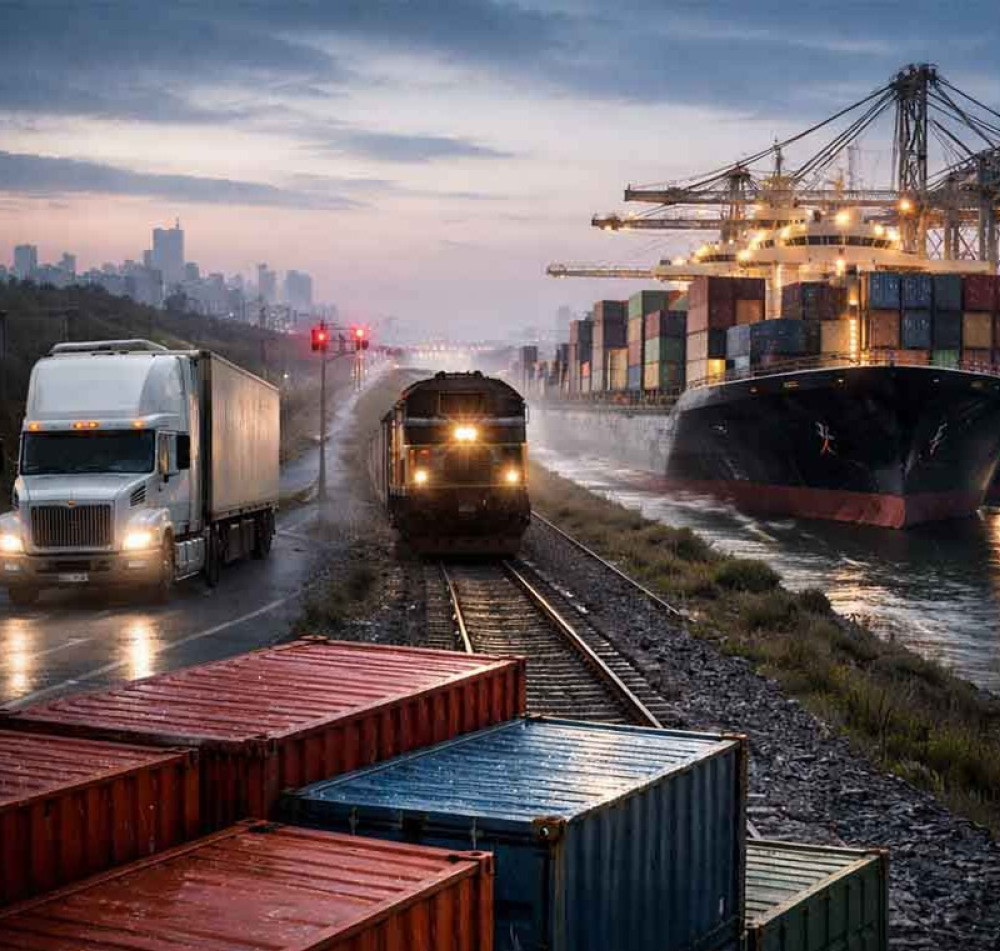
Road vs Rail vs Sea: How Businesses Choose Routes in Conditions of Instability
Introduction
Why has the choice of transportation mode become non-obvious even for experienced market participants? Why do decisions that were once considered standard now produce unstable results and lead to additional costs? In 2026, the choice between road, rail, and sea transport is no longer reduced to a simple comparison of speed and cost. It has turned into a complex task that requires accounting for variability in delivery times, disruption risks, and the impact of logistics on the overall business economics.
The core issue is that each mode of transport retains its fundamental advantages while simultaneously facing new constraints. Road transport remains flexible but is becoming more expensive and dependent on operational factors. Rail transport remains scalable but less predictable in terms of timing. Sea transport remains cost-efficient but is highly sensitive to congestion and long cycle times. As a result, businesses are no longer choosing the “best” option but are trying to find a balance between parameters that often contradict each other.
Why the Traditional Decision Logic No Longer Works
The traditional route selection model was based on comparing key parameters: speed, cost, and volume. Each mode of transport occupied its own niche, and decisions were made based on clear advantages. However, under current conditions, this model is losing relevance because these parameters are no longer stable.
The key problem is the growing variability. Delivery times are no longer fixed, and costs are subject to fluctuations. This makes direct comparison ineffective, as the actual outcome can differ significantly from the calculated one. As a result, decisions based on nominal indicators increasingly lead to errors.
Additionally, the role of logistics in business is changing. It is no longer a supporting function but becomes part of the financial model. This means that route selection must take into account not only transport parameters but also the impact on inventory, turnover, and operational processes. In such a system, simple comparison of transport modes is no longer sufficient.
Road Transport: Flexibility with Rising Costs
Road transport retains its key advantage — flexibility. It allows for rapid adaptation to changes, route adjustments, and handling of varying volumes. This makes it particularly attractive in unstable conditions where quick response is required.
However, flexibility comes with rising costs. The cost of road transportation is increasing not only due to tariffs but also because of operational factors, including load factors, resource availability, and variability of conditions. This makes the cost structure less predictable.
Additionally, there is a scalability issue. Road transport is less efficient when handling large volumes, which limits its use in certain scenarios. As a result, it becomes a tool for solving specific tasks rather than a universal solution.
Rail Transport: Scale Without Time Guarantees
Rail transport has traditionally been used for moving large volumes at relatively low cost. It provides high efficiency under stable conditions and allows for cost reduction per unit of cargo.
However, under conditions of instability, its key advantage weakens. Delivery times become less predictable, and process management becomes more complex. This is due to a strong dependence on infrastructure and limited flexibility.
Additionally, synchronization becomes a challenge. Rail transport requires stricter planning, which reduces the ability to adapt to changes. As a result, businesses face a situation where cost savings are achieved at the expense of increased risks.
Sea Transport: Lowest Cost, Longest Cycle
Sea transport remains the most cost-efficient option for moving large volumes over long distances. It significantly reduces costs and serves as the backbone of many supply chains.
However, its key limitation is the long delivery cycle. This increases transit time and reduces inventory turnover. In unstable conditions, this becomes a critical factor, as any deviations are amplified due to the duration.
Additionally, sea transport is subject to congestion, which increases variability in delivery times. This makes it less predictable and complicates planning. As a result, cost savings may be accompanied by significant risks.
The Economics of Choice: Hidden Parameters
The choice between transport modes can no longer be based solely on direct costs. It is necessary to consider the total economic impact, including effects on inventory, lead times, and operational processes.
Key parameters that are often underestimated:
- variability of delivery times
- impact on turnover
- operational costs
- disruption risks
These factors shape the real cost, which may differ significantly from the nominal one.
It is also important to consider the impact on the entire supply chain. Route selection affects not only transportation but also production, warehousing, and sales. This makes the decision more complex, but also more critical.
How Businesses Adapt to Instability
In 2026, companies are shifting toward hybrid models. They use different modes of transport depending on conditions, distributing risks and optimizing costs. This increases resilience but also adds management complexity.
Additionally, the role of analytics is strengthening. Decisions are increasingly data-driven rather than intuitive, allowing for more accurate risk assessment. This reduces the likelihood of errors and improves efficiency.
Planning approaches are also changing. Companies begin to account for variability and develop scenarios, enabling them to adapt to changes. This makes logistics more flexible and resilient.
Where Businesses Lose Money
The main losses arise from incorrect route selection and underestimation of key factors. Companies often focus on minimizing cost or maximizing speed without considering the overall economics.
Key loss areas include:
- choosing an unsuitable mode of transport
- underestimating risks
- increased inventory levels
- supply chain disruptions
These factors lead to reduced efficiency and higher costs.
Mistakes of Carriers and Clients
Carriers often offer solutions based on their own capabilities rather than the client’s needs. This creates a mismatch between the proposed solution and the actual task.
Clients, in turn, continue to rely on outdated decision models. They focus on nominal indicators while ignoring variability and risks.
Additionally, there is a lack of transparency. Insufficient information complicates decision-making and increases the likelihood of errors.
Emerging Trend: From Selection to Management
A key trend is the shift from choosing a transport mode to managing the logistics system as a whole. Companies begin to view transportation as part of an integrated model rather than an isolated decision.
This includes data integration, risk management, and process adaptation. As a result, logistics becomes more complex but also more efficient.
Flexibility is also becoming increasingly important. The ability to quickly change decisions becomes more valuable than optimizing each individual choice.
Conclusion: No Best Transport, Only the Right Model
The key conclusion is that in 2026 there is no universally best mode of transport. Each has its own advantages and limitations, which manifest differently depending on conditions.
Companies that understand this build flexible models and adapt to change. They treat route selection as part of a system rather than a standalone decision.
Those who continue to rely on simple criteria face rising costs and declining efficiency. Ultimately, success is determined not by the choice of transport, but by the ability to manage logistics effectively.
Your experience matters! Take a short survey and see how others answered. Take part